
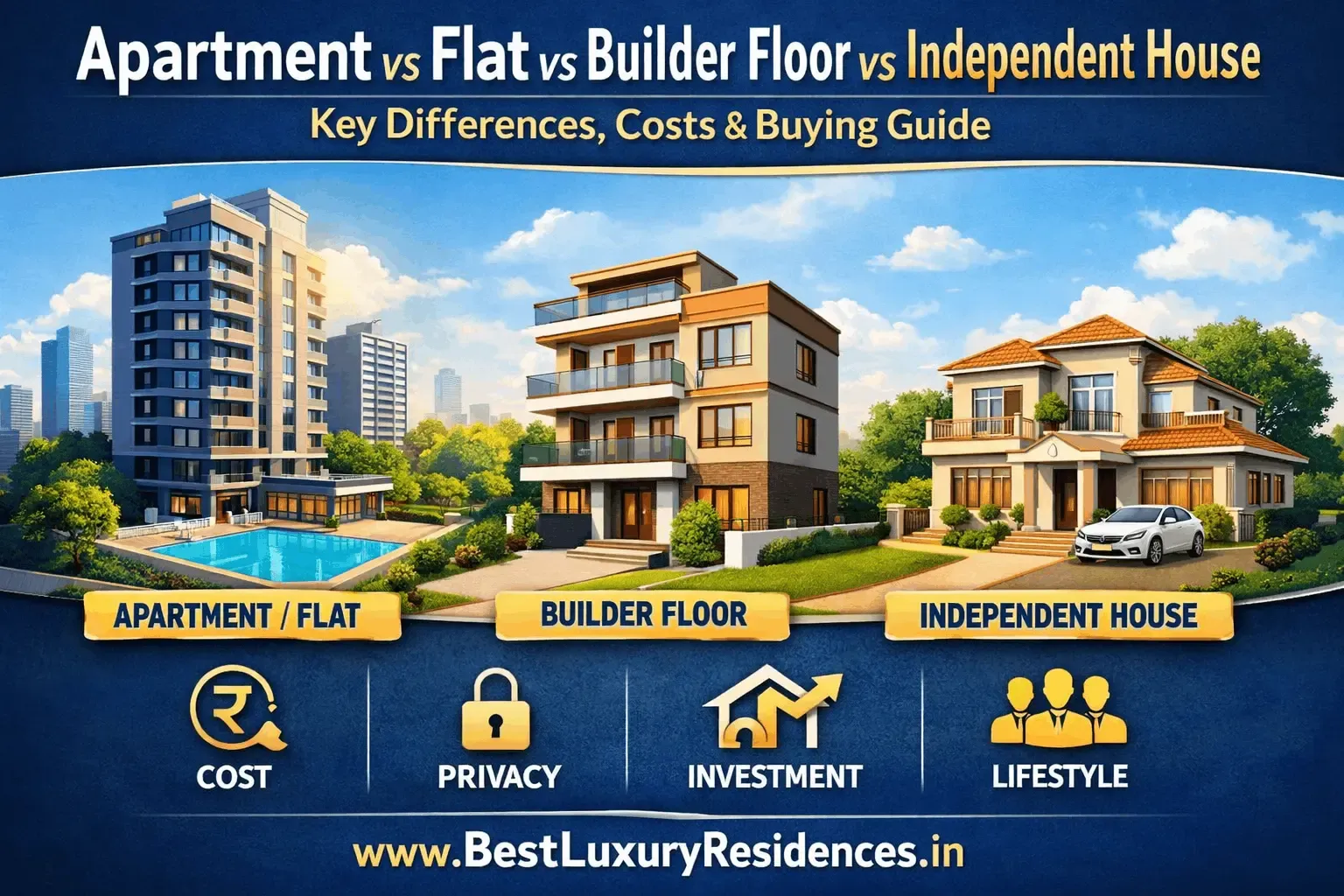
Purchasing a home is one of the most significant decisions you will ever make. Your decision not only impacts your budget but also your lifestyle, comfort, and future investments. In India, you have a wide range of choices available—apartments, flats, builder floors, and independent houses, designed to suit different budgets, needs, and lifestyles.
This guide will help you understand the differences between an apartment vs flat and an independent house vs apartment. By the end of this guide, you’ll learn the main differences, costs, lifestyle impacts, and investment possibilities of each type of home, so you can make a smart and confident choice.
What You Will Learn in This Guide
- Differences between apartments, flats, builder floors, and independent houses
- Advantages and disadvantages of each type
- Cost comparison and investment opportunities
- Lifestyle differences and privacy
- FAQs addressing common queries
What Is an Apartment?
An apartment is a self-contained residential unit within a multi-storey building. It normally belongs to a larger society or complex and shares facilities such as elevators, gardens, security, parking lots, gyms, and clubhouses.
In India, the apartment vs flat debate is a common phenomenon where the two terms are used interchangeably. The use of the two terms is normally dependent on the region.
Advantages of Apartments:
- Maintained security and maintenance
- Shared spaces for fun and activities
- Community living space
- Easier rental and resale value
Disadvantages:
- Limited privacy due to shared walls and corridors
- Limited scope for modifications.
What Is a Flat?
A flat is a self-contained dwelling unit within a multi-story building. It is normally a part of a residential building or society where many families live together. Flats can also share common facilities such as staircases, parking, and security.
Advantages of Flats
- Relatively cheaper compared to independent houses
- Basic security and shared maintenance
- Easy access to daily amenities
- A good choice for renting or resale
Disadvantages of Flats
- Less privacy due to shared walls
- Limited flexibility for customization or renovation
- Shared common areas with other residents
Apartment vs Flat — Is There Any Difference?
The terms apartment and flat are essentially equivalent. Both describe self-contained units in multi-story buildings with shared amenities. Variations are purely geographical:
- “Flat” is preferred in India and the UK
- “Apartment” is preferred globally in marketing
In simple terms: All flats are apartments, and all apartments in India are often called flats.
Summary Table: Apartment vs Flat
|
Feature |
Apartment |
Flat |
|---|---|---|
| Ownership | Self-contained unit within a multistorey building | Self-contained unit within a multistorey building |
| Amenities | Shared | Shared |
| Privacy | Moderate | Moderate |
| Cost | Lower than an independent house | Lower than an independent house |
| Suitable for | First-time buyers, working professionals | First-time buyers, small families |
What Is a Builder Floor?
A builder floor is a residential property that takes up an entire floor of a low-rise building (usually 2-4 floors). Each floor has a separate entrance, and fewer families live in the building, providing more privacy than an apartment.
Key Features:
- Reasonable pricing
- Minimal common amenities
- More private than regular apartments
Advantages of Builder Floors:
- Similar to a small independent house
- Easier maintenance than large apartment complexes
- Interior flexibility
Disadvantages:
- Minimal common amenities such as gyms or pools
- Parking space could be a problem
What Is an Independent House?
An independent house is a self-contained residence on its own land. The buyer will possess the property as well as the land.
Advantages:
- Maximum privacy and area
- Ability to alter, renovate, or extend
- Potential for high long-term investment
Disadvantages:
- Higher upfront cost
- Responsibility for maintenance and security
- Limited interaction with the community
Independent House vs Apartment — Key Differences
|
Feature |
Apartment / Flat |
Independent House |
|---|---|---|
| Ownership | Unit + share of common areas | Entire house + land |
| Privacy | Shared walls/floors | Fully private |
| Maintenance | Society-managed | Owner-managed |
| Customisation | Limited | Full freedom |
| Cost | Lower upfront | Higher upfront |
| Amenities | Shared | Self-arranged |
| Resale Value | Moderate to high | Potentially high long-term |
Key Takeaways:
- Apartments are ideal for convenience and budget-conscious buyers
- Independent houses suit buyers who value space, privacy, and long-term investment. If land, space, and exclusivity are priorities, see our listings for ultra-luxury houses in Gurgaon.
Cost Comparison
Budget is often the deciding factor in choosing a property.
|
Property Type |
Price Range (INR) |
Maintenance |
Resale Potential |
|---|---|---|---|
| Apartment / Flat | ₹50 Lakh – ₹2 Cr | Shared | Moderate to High |
| Builder Floor | ₹1 Cr – ₹3 Cr | Shared / Moderate | Moderate |
| Independent House | ₹1.5 Cr – ₹5 Cr | Self-managed | High |
Tip: Apartments are easier for first-time buyers due to lower upfront costs, while independent houses require higher investment but may appreciate more over time.
Lifestyle and Amenities Comparison
|
Feature |
Apartment / Flat |
Builder Floor |
Independent House |
|---|---|---|---|
| Security | Society-managed | Some security | Self-managed / gated |
| Parking | Common | Shared | Private |
| Green Areas | Shared gardens | Limited | Private (if plot allows) |
| Community | High | Medium | Low |
| Noise Levels | Moderate | Low | Low |
| Entertainment Facilities | Gym, pool, clubhouse | Rare | Self-arranged |
Privacy and Space
|
Property Type |
Privacy |
Space |
|---|---|---|
| Apartment / Flat | Moderate | Moderate |
| Builder Floor | High | Good |
| Independent House | Very High | Excellent |
Independent houses are ideal for families who prioritize space and seclusion. Apartments are best for buyers seeking community living and shared amenities.
Customization & Renovation
|
Property Type |
Renovation Flexibility |
Restrictions |
|---|---|---|
| Apartment / Flat | Interiors only | Structural changes restricted |
| Builder Floor | Moderate | Limited structural changes |
| Independent House | Full control | Must follow local building rules |
Investment Perspective
|
Property Type |
Investment Trend |
Liquidity |
|---|---|---|
| Apartment / Flat | Stable rental income | High resale demand |
| Builder Floor | Moderate | Medium resale demand |
| Independent House | Appreciates with land value | Lower liquidity but high long-term value |
Pros and Cons Summary
| Property Type | Pros | Cons |
|---|---|---|
| Apartment / Flat | Affordable, shared amenities, security, and rental potential | Less privacy, limited customization |
| Builder Floor | Privacy, moderate cost, spacious | Fewer amenities, limited parking |
| Independent House | Full privacy, freedom, land ownership, long-term value | Higher cost, self-maintenance, lower community engagement |
When to Choose an Apartment or Flat
Apartments/flats are best suited for you if:
- You have a limited budget
- You want managed amenities
- You like living in a community
- You want rental potential
When to Choose an Independent House
Independent houses are best suited for you if:
- You want privacy and control
- You want ownership of land
- You want to customize or expand
- You want long-term appreciation
Builder Floor — The Middle Option
Builder floors balance affordability and privacy:
|
Feature |
Builder Floor |
|---|---|
| Privacy | High (few neighbors) |
| Cost | Moderate |
| Amenities | Limited |
| Maintenance | Shared / Moderate |
| Suitable For | Families seeking space without paying for land |
City-Wise Trends
|
City |
Apartment Demand |
Independent House Demand |
Builder Floor Demand |
|---|---|---|---|
| Mumbai | High | Low | Moderate |
| Delhi NCR | High | Moderate | Moderate |
| Bangalore | High | Moderate | Low |
| Pune | Moderate | High | Low |
Observation: Apartments dominate in metro cities due to limited land, while independent houses are more common in residential or suburban areas and tier-2 cities.Gurgaon sees strong demand for upscale homes — check ultra luxury apartments in Gurgaon for top choices.
Legal and Maintenance Factors
Apartments
- Ruled by housing societies
- Maintenance fees are paid every month
- Any renovation work needs approval from the housing society
Independent Houses
- Owner’s responsibility for maintenance, security, and repair
- Need to adhere to local building norms
- Provides complete freedom to make any changes
Builder Floors
- Shared maintenance or limited maintenance
- Need clear agreements regarding use of common areas, parking, and security
Quick Checklist Before Buying
- Budget and EMI calculation
- Location and connectivity to work, schools, and hospitals
- Privacy and noise tolerance
- Maintenance responsibilities
- Expansion possibilities
- Resale and rental possibilities
- Legal approvals (RERA compliance, property title)
FAQs — Apartment vs Flat & More
Q1. Are apartments and flats the same?
Yes. They refer to the same housing unit inside a multi-storey building.
Q2. Which is better: independent house or an apartment?
Depends on budget, privacy, and lifestyle. Apartments are convenient; independent houses offer freedom.
Q3. What is a builder floor?
A single-floor unit in a low-rise building, usually 2-4 floors.
Q4. Can independent houses be expanded?
Yes, with proper approvals and as per local laws.
Q5. Do apartments have maintenance charges?
Yes, for shared facilities and security.
Q6. Which property type has higher long-term value?
Independent houses may have higher value because of the land, but apartments give steady rental returns.
Q7. Are apartments safer than independent houses?
Apartments usually have proper security systems, but independent houses may need personal security arrangements.
Q8. Which property is easier to resell?
Apartments are easier to resell because they are priced low and in high demand.
Conclusion
Apartment vs flat, builder floor, or independent house, which one to choose? This depends on your personal preferences:
- Apartment: Best for convenience, amenities, and budget-friendliness
- Builder Floors: Privacy without the price tag, fewer amenities
- Independent Houses: Ultimate freedom, space, and future appreciation
Each has its pros and cons. Assessing your lifestyle, budget, and future goals will guide you in making the right choice.
**Key Takeaway:** There is no right or wrong choice. The “best” property is one that best suits your personal preferences, whether it is convenience, privacy, investment, or lifestyle. Assess each option, budget accordingly, and make a decision that will help you achieve your long-term goals. This way, you can be assured that your new home not only serves your needs but also becomes a valuable asset in the years to come.
