
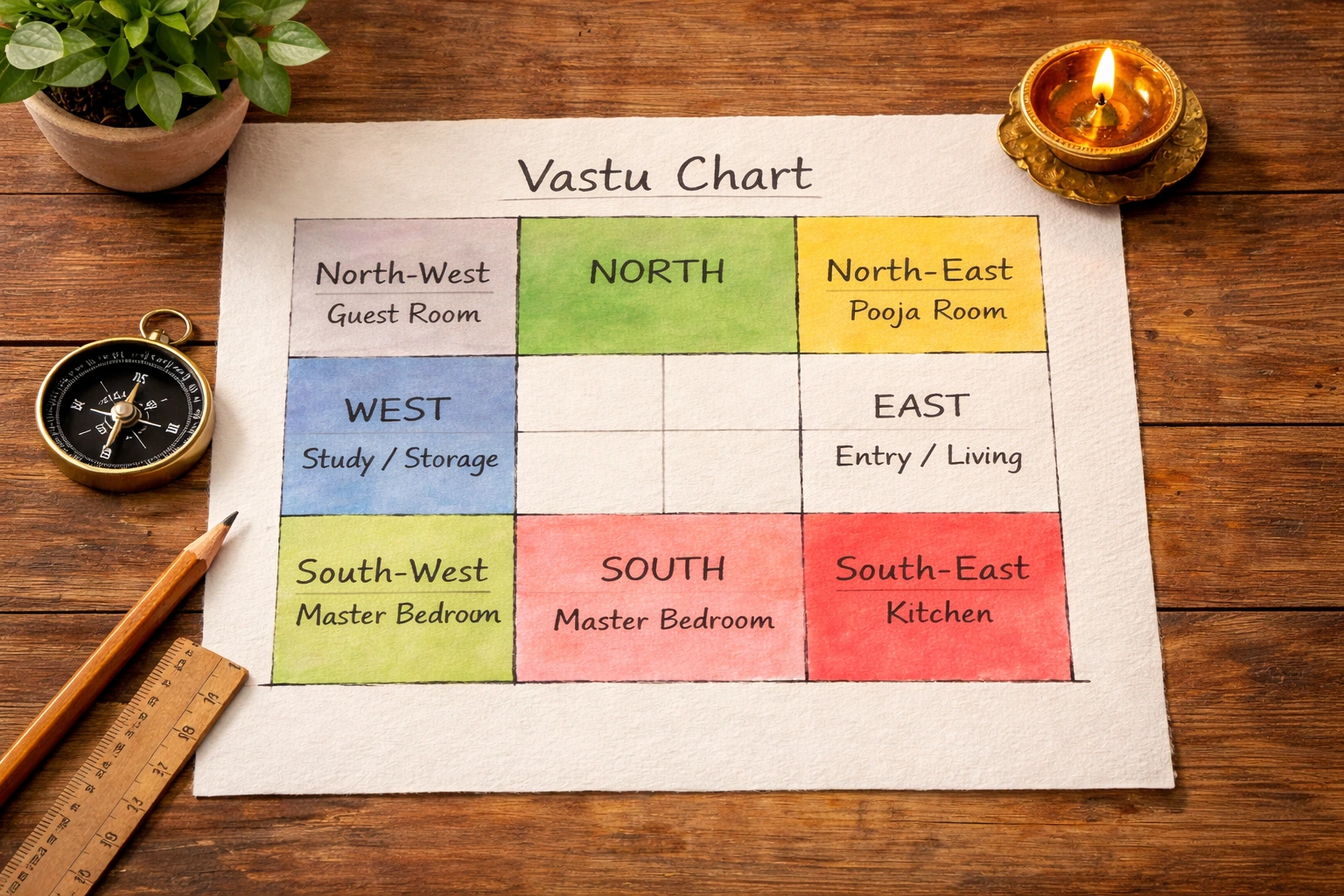
A vastu chart is like a simple direction map for your home. It will guide you on how to place important rooms in your home, such as the kitchen, bedroom, living room, and pooja room, so that your home feels peaceful, bright, and balanced. If you follow a vastu chart with clear and simple vastu directions, your home can feel more comfortable, your daily routine can run more smoothly, and the overall atmosphere can become more positive and peaceful.
In this guide, you will learn the direction according to vastu in very simple terms, along with colors, planets, and layout tips that you can apply in 2026.
What is a Vastu Chart and why is it used?
A vastu chart is a home planning guide that is based on Vastu Shastra. It is a diagram that illustrates the positioning of rooms, doors, windows, and furniture according to the four main directions: East, West, North, and South. The aim is to design a dwelling that is well-balanced and promotes health and positive thinking.
A vastu chart is also used by many individuals to ensure that the house remains organized and that the house “feels” good, especially when purchasing a new home.
Important Vastu directions and their meanings
Each direction in a vastu direction chart is associated with a meaning and a positive attribute. Directions are also associated with gods (for instance, East with Indra, West with Varun, North with Kuber, and South with Yama).
Here’s a basic explanation of direction according to vastu:
- East: new energy and sunlight (most suitable for entry and public spaces)
- North: prosperity and advancement (commonly associated with storing precious things)
- North–East: peaceful and spiritual area (most suitable for pooja/meditation room)
- South–East: fire area (most suitable for kitchen)
- South–West: stability and grounding (most suitable for master bedroom)
- North–West: motion and change (most suitable for guest room/multi-functional spaces)
Vastu direction chart: Colours and Planets (easy table)
A major part of a vastu chart is the link between colours, directions, and planets. The reference chart below is widely repeated across real estate and Vastu guides.
|
Direction |
Planet |
Colour (best pick) |
Simple use idea |
|---|---|---|---|
| East | Sun | White | Entry, living area |
| West | Saturn | Blue | Dining/ study corner |
| North | Mercury | Green | Work/ study, money area |
| South | Mars | Pink / Coral / Red | Storage, activity zone |
| North-East | Jupiter | Yellow / Cream | Pooja/ meditation |
| South-West | Rahu | Green shades | Master bedroom |
| South-East | Venus | Silver / White | Kitchen |
| North-West | Moon | White | Guest room |
Tip: Use light shades. Very dark colours in small rooms can feel heavy, even if the direction is “right”.
Room positioning according to vastu chart
Entrance (Main Door) according to vastu directions
East and North are considered the best directions for a welcoming and positive feeling because they bring more light and openness. The entrance should always be clean, bright, and free from clutter so that the home gives a good first impression.
While East and North entrances are considered highly auspicious, many modern homes are South-facing. If you own one, don’t worry — proper planning can balance the energy. Read our complete guide on South facing house Vastu rules to understand entrance corrections and layout tips.
Kitchen positioning (Most important Fire Zone)
The kitchen should be positioned in South-East (Agni zone). This zone is associated with the fire element and is the most preferred zone for cooking energy and home prosperity. If South-East is not feasible, North-West is the next preferred zone.
Avoid positioning the kitchen directly opposite the main entrance.
Bedroom positioning (Sleep = Recovery Zone)
The master bedroom should be positioned in South-West for stability and grounded energy. Children’s bedrooms can be positioned in West or North-West. South-East bedrooms are generally avoided because the fire-zone energy can cause restlessness.
Pooja/meditation area
The North-East corner is considered the most auspicious corner. It should be kept light, clean, and peaceful. A heavy storage room or a cluttered corner in this area is not recommended.
Living room/Family sitting area
North, North-East, or East is considered ideal for living rooms, as these areas feel more open, social, and sunny. (Even in a compact apartment, the principle is the same: keep the sitting areas closer to light and air.)
Practical tips from a vastu chart that you can apply without renovation
A vastu chart is more than just the direction of each room in the house. It also involves other habits that you should practice:
Remove unnecessary items and keep your house clean and tidy.
Less clutter means easier movement and less weight. A vastu chart is also applied specifically for the purpose of keeping your house clean and fresh.
Enhance ventilation and lighting
Air and light keep the house fresh. A well-lit and well-ventilated room is ideal for promoting a positive environment.
Maintain harmony of the five elements in the house
A vastu chart may involve the concept of balancing the five elements: earth, water, fire, air, and space in various corners of the house. South-West is usually used for stability (earth), while South-East is used for fire (kitchen).
Furniture placement (easy-to-apply rules)
- Leave pathways clear—don’t block doors or walking areas.
- Avoid pointing sharp corners of furniture directly at the bed.
- Keep heavier furniture in South-West, if possible (it feels more grounded).
Vastu colors for rooms (quick 2026 guide)
If you want to follow the vastu direction chart in a practical way, start by choosing colours for each room carefully. Try to use only 2–3 matching colours in one room so that the space looks balanced and not too crowded.
Quick room color schemes:
- Bedroom: blue/green colors (soothing), avoid bright reds
- Living room: warm and friendly colors (light yellow/orange), avoid loud colors
- Kitchen: warm energy colors (orange/red)
- Pooja room: light yellow/cream
Mistakes to avoid (people tend to do these a lot)
- Using too many colors in one house (energy feels scattered)
- Ignoring correct direction alignment while using a vastu chart
- Blocking ventilation and sunlight with heavy curtains/furniture
- Keeping the North-East heavy, messy, or used as a storage dump.
FAQs
1) What is the use of a vastu chart?
A vastu chart helps in the proper placement of rooms, doors, windows, and key furniture according to vastu directions to create a balanced and positive environment.
2) What is the best direction for a kitchen according to vastu?
South-East is the best kitchen corner in a vastu direction chart as it corresponds to the fire element.
3) What is the best direction for a pooja room?
North-East is the best direction for prayer and meditation.
4) Where should the master bedroom be according to vastu directions?
South-West is the best direction for the master bedroom.
5) Do colours have any importance in a vastu chart?
Yes, many vastu direction chart guides relate colours to directions and planets. People opt for these colours to create a peaceful environment and better balance at home.
6) Can I apply vastu in a small apartment?
Yes. Even without altering the walls, you can apply the direction according to vastu by placing furniture accordingly, removing clutter, improving lighting/ventilation, and choosing proper colours.
Conclusion
A house becomes more peaceful if it is designed in a simple and balanced manner. A vastu chart helps in this regard by providing simple guidelines on how to arrange rooms, use colors, and implement simple design concepts. By following vastu guidelines along with proper lighting, ventilation, reduced clutter, and proper room design, your house becomes a more positive and pleasant place to live in.
If you want, please share the direction your house faces (north, east, west, or south) and your house type (2BHK or 3BHK). I can help you with a simple vastu checklist for your house.
